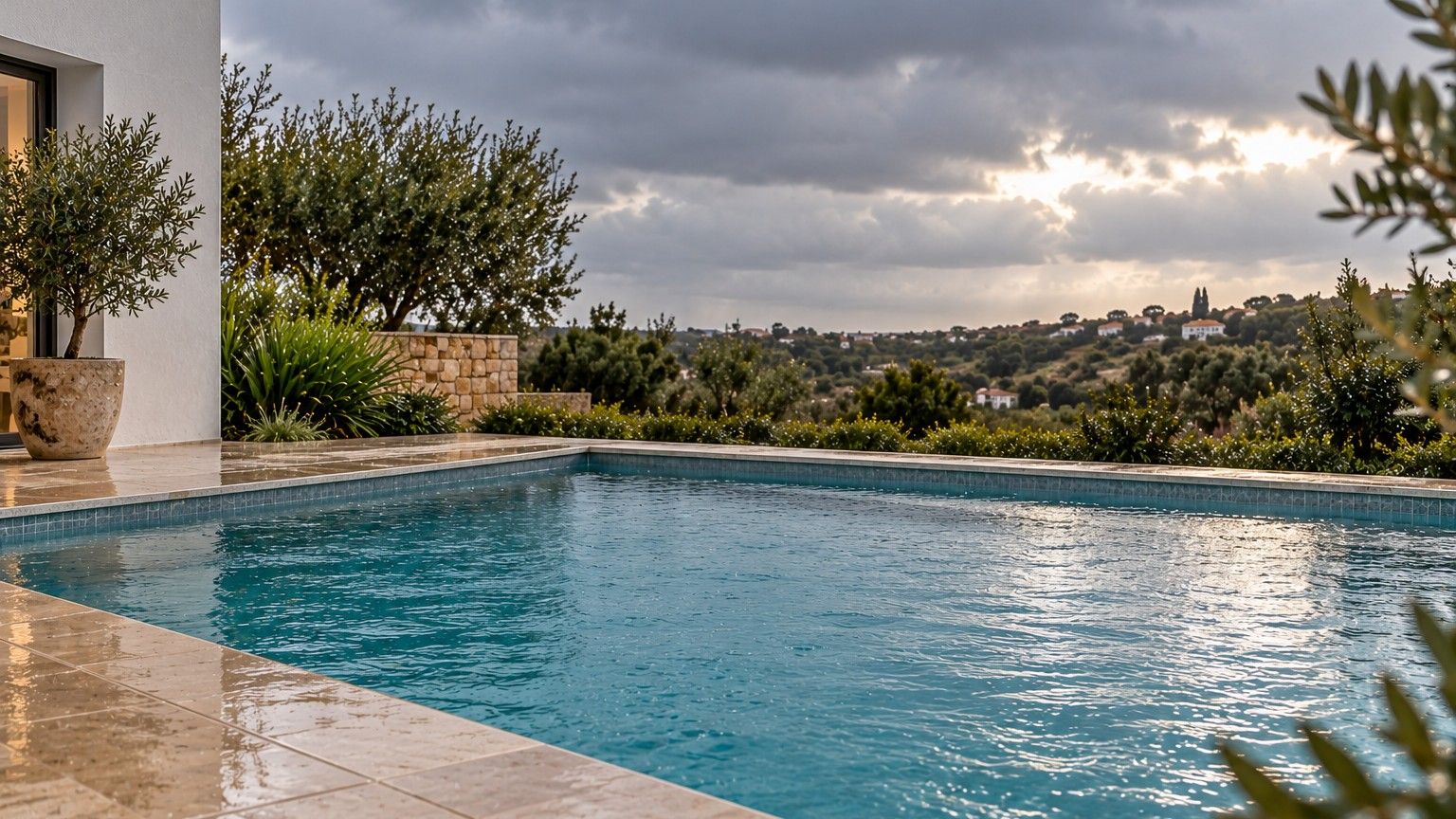
Closing Your Pool for Winter in the Algarve
The winterising ritual that fills pool blogs every autumn was written for climates that freeze. In Faro's coldest month, the average minimum temperature is 8.3°C. Here is what an Algarve winter actually does to a pool, and why the quiet months are the best of the year to find a leak.
Every autumn the pool blogs fill with instructions for closing your pool for winter: drain the lines, blow out the pipework, fit the antifreeze plugs, pull the safety cover over and walk away until April. Almost all of it was written for climates that freeze. The Algarve is not one of them, and the pools that cause trouble in spring are, with depressing regularity, the ones that were shut down and forgotten in October.
What follows is what an Algarve winter actually does to a pool, what is worth doing before it arrives, and why the quiet months are the most useful of the whole year for finding out what is wrong with your pool.
Should you close your pool for the winter in the Algarve?
For most pools here, no. Full winterisation exists to stop water freezing inside pipes and cracking them, and that risk is close to absent in this region. The Faro climate normals for 1991 to 2020 put the mean minimum temperature in January, the coldest month, at 8.3°C (Instituto Português do Mar e da Atmosfera, normals 1991 to 2020, station 554).
The extremes tell the same story. Across those thirty years the lowest minimum recorded at the Faro station was minus 0.3°C, on 5 February 2012. The coldest night in three decades barely went below zero. Draining the system in a climate like this solves a problem the Algarve does not have, and it introduces problems it does: dry seals perish, empty pipework shifts, and a still pool grows things that a circulating one does not.
There is a narrow set of exceptions. Pools at altitude in the interior of the Algarve, pools that will genuinely stand unused and unvisited for the whole winter with nobody to look at them, and pools already scheduled for refurbishment are all cases where shutting down makes sense. Most pools on the coast and in the central Algarve are none of those.
What does an Algarve winter actually do to a pool?
It rains on it, mostly. The same climate normals give December, January and February a combined 181.2 millimetres of rainfall at Faro. On a pool of 32 square metres that is roughly 5,800 litres of rainwater landing directly in the water over those three months, and 2,880 litres of it in December alone.
That volume is the winter problem in one number. Rainwater is soft and carries nothing with it, so it dilutes what is already in the pool: the salt in a salt pool, the alkalinity that holds pH steady, the stabiliser that protects chlorine from sunlight. A pool left alone through a wet winter does not usually turn green from neglect in the summer sense. It drifts, quietly, until the balance it needs in April has to be rebuilt from scratch.
Add to that the debris a winter storm puts in an uncovered pool, and the two months of warm spring sun that arrive before anyone thinks about swimming. This is how spring problems usually start: nothing dramatic happens, but nobody is keeping an eye on the water.
An automatic pool cover removes most of this at once, since it keeps the rain, the leaves and the winter dirt out of the water instead of leaving you to deal with them afterwards. Whether one is worth the outlay is a separate question, and we have answered it at length in our article on automatic pool covers in the Algarve.
Why is winter the best time to find a leak?
Because it is the only time of year when the water balance is simple enough to read. In summer a falling level has four plausible explanations at once: evaporation, splash-out, backwashing and bathers carrying water out on themselves. In January there is, in practice, only one.
The numbers make the point better than the argument does. Research on pools in the Balearic Islands, climatically close to the Algarve, found that the months from November to March account for only a fifth to a quarter of the whole year's evaporation, while evaporation in July alone can reach 200 millimetres (Hof and colleagues, Water 10(12):1883, 2018). Set that against the 181.2 millimetres of rain that falls into the pool between December and February alone, and the picture is plain. A pool whose level keeps dropping through an Algarve winter is not losing its water to evaporation.
This is the part owners tend to get backwards. Water loss noticed in August is ambiguous and usually watched for another month. The same loss noticed in January is very nearly a diagnosis. We operate the only electronic leak detection equipment in Portugal, and the winter surveys are consistently the cleanest to interpret, because nothing else is competing to explain the missing water.
If your level has been falling through the autumn, the bucket test takes a day or two, and the method is set out in full in our article on how to tell if your pool is losing water. Where the test points to a leak, our electronic leak detection survey locates it with the pool still full.
What is worth doing before winter?
Less than the internet suggests, and the list of useful jobs is short. Keep the water circulating on a reduced winter schedule rather than stopping it. Keep the water balanced, because the rain will work against it all season. Cover the pool if you have a cover. Clear the surround of anything that could blow in. That is close to the whole list.
Each piece of equipment deserves a moment's thought. A salt chlorinator will need its salt level checked after heavy rain, which dilutes it. A heat pump is the only piece of kit that does more than see the pool through the winter: it extends the swimming season, and the economics of running one are set out in our article on how a pool heat pump works. Automatic water level control, such as INDYGO Pool Level, earns its place in winter more than at any other time, because it records how much water the pool uses while nobody is watching.
The physical work at the pool through the winter still has to be somebody's job, and that arrangement is yours to make. What we would say is that, in winter, how often the pool is checked matters more than how much work goes into it. A pool looked at every week through January needs very little doing to it. A pool first looked at in April needs a great deal.
Why is winter the right window for refurbishment?
Because the work needs the pool out of use, and in winter it already is. Retiling, relining, replacing a failed skimmer or reworking the surround are all jobs that take the pool offline for a stretch, and doing them between November and March costs you no swimming time.
Winter also exposes what summer hides. A pool full of people in August is a pool nobody is inspecting. When the pool is drained or quiet in January, the tired grouting, the lifting tiles at the waterline and the movement in the surround are all plain to see. Our article on pool refurbishment in the Algarve sets out where the line between a repair and a renovation falls, and our pool refurbishment service covers the work itself.
What does Just Pools advise?
Treat winter as the season when the pool is easiest to understand, not the season to forget about it. Leave it running on a reduced schedule, keep an eye on the balance, and use the quiet to settle the questions that summer makes unanswerable. If the level has been falling, find out why now, while the answer is unambiguous. If the pool has been looking tired for two summers, this is the window in which something can be done about it without losing a season.
Just Pools Algarve has been working on pools in this region since 2008, and the single pattern worth passing on is that the April problem is almost always the October decision. If your pool has been losing water, get in touch.
Frequently asked questions
Do I need to winterise my pool in the Algarve? In most cases, no. Winterisation protects pipework from freezing, and the Faro climate normals for 1991 to 2020 give a mean January minimum of 8.3°C, with a lowest recorded minimum of minus 0.3°C across the entire thirty-year period. Reduced circulation suits this climate far better than a full shutdown.
Will my pool turn green over the winter? Not usually, and not in the way a summer pool does. The winter risk is dilution rather than algae: roughly 5,800 litres of rain fall into a 32-square-metre pool between December and February, thinning the salt, alkalinity and stabiliser until the balance has to be rebuilt in spring.
Can leak detection be carried out in winter? Yes, and winter is the better season for it. Evaporation between November and March accounts for only a fifth to a quarter of the annual total, so a falling level has almost no innocent explanation. The survey is carried out with the pool full, whatever the time of year.
Should I drain the pool if I am not using it until summer? No. An empty pool is more vulnerable than a full one, because the water is what holds the structure in balance against the ground around it, and dry seals and fittings deteriorate. Drain a pool only as part of planned refurbishment work.
What happens to the salt level over the winter? It falls, because rain dilutes it. Roughly 5,800 litres of rainwater enter a 32-square-metre pool between December and February, and once the salt level falls below its target, a salt chlorinator can quietly stop producing chlorine. Check the salt after any long wet spell instead of waiting for spring.